Surrounded by venal enablers, our two candidates have morphed into the same person. Oh, we always understood Trump’s pathology, fully on display in his convention speech. No amount of praise and false love will fill the hole in his soul. But Joe Biden fooled us, didn’t he? Clearly in steep mental decline, he has become what he claims to hate, the grasping narcissist, demanding we ignore what we see and exclaiming to the sky, in a messianic pose, that he is the only who can save us from evil. Saying only god can dissuade him. Think of it, “only God above.”
As I watch this tragedy unfold, I am drawn constantly to my recently departed father. We are car people, the Blackwood family. Dad was the icon. He and mom travelled hundreds of thousands of miles side by side. Going for a ride was how you relaxed, how you talked it out, and how you absorbed the world around you. In his mid-80s, dad decided he was going to drive from Southern California to Phoenix to see his beloved Dodgers at spring training. So, I got his tickets for him, then he loaded his walker in his car and set out. He saw the Dodgers, then made a side trip to see the Grand Canyon one more time. He was in his element behind the wheel.
One day, after that trip, dad announced he was selling his car because the pain in shoulder was so aggravated by the seatbelt. But here’s the nature we don’t see in Biden. He said he could bear the pain, but he needed to stop driving because he was worried his pain would distract him and he might accidentally harm someone else with his car. This is the grace Biden does not have. We should all be so aware of ourselves and others to make such a momentous decision.
Millions of Americans have experienced the dynamics that faced my father. There is that moment that for the sake of others, the family gathers and tells their elder that it is time to take the car keys. We all have seen this happen or heard the stories of friends who have had to do this. It is through these eyes that people, not elites, not the media, we normies living our lives, now see Joe Biden. He is a man who has done good work, and now, like all of us one day, the debt to father time must be paid.
Here, the stakes are mindboggling. It’s America that will pay if the other mentally decaying old man is elected. I called for Biden not to run in an essay over a year ago. I have gone from concern to frustration to rage at seeing him the last few months. How dare he say that if he loses, he will be satisfied if he did his best. That is a narcissist speaking. Worse, Joe Biden will be fine if Trump wins. He is just another rich, old white guy completely insulated from the impending disaster. I don’t give a damn about his feelings, Jill’s problem or the goals of is sycophants. If he is in anguish, he brought it upon himself. Be gone or be damned.
Clearly, the only path to stop Trump is a younger candidate. This was always true and is now in stark relief. Last night, in his speech, the evil MAGA icon rolled over and exposed his belly. He is vulnerable, waiting for a political pummeling. Yet today, what do we hear from Biden? He’s still in and will be back next week. NEXT FUCKING WEEK!!!? America has to wait for yet another recovery as Trump gains more momentum?
This is time for bold moves and chaos. The media loves chaos and dumping Biden for a new, younger candidate would suck in all the air in the race. Embrace chaos. Embrace change. The contrast in age and energy alone will give any candidate a 5 point bump. Harris? For every racist, misogynist we lose, we retake young people and independents among the 70% of voters starved for someone new. Right now, all is lost. President, House and Senate. We have the history. A presidential wipeout destroys layers of down ballot Democrats. If a new candidate merely keeps it close, we would could take the House as a bulwark to Trump. The math in the Senate was always awful. Democrats are toast there. But there we have the filibuster if we can keep it in range.
Since I was 12 years old, I have been a political junkie. I love it. I love America. I love the business of campaigns. But now, if Biden stays in, I don’t know. I may have to walk away from my passion to save my soul. We are hanging by a thread. Don’t ignore the evidence of your eyes. Contact your representatives and tell them Biden is done. This is a change election. Either Trump can be the change or a younger Democrat. Time to choose.
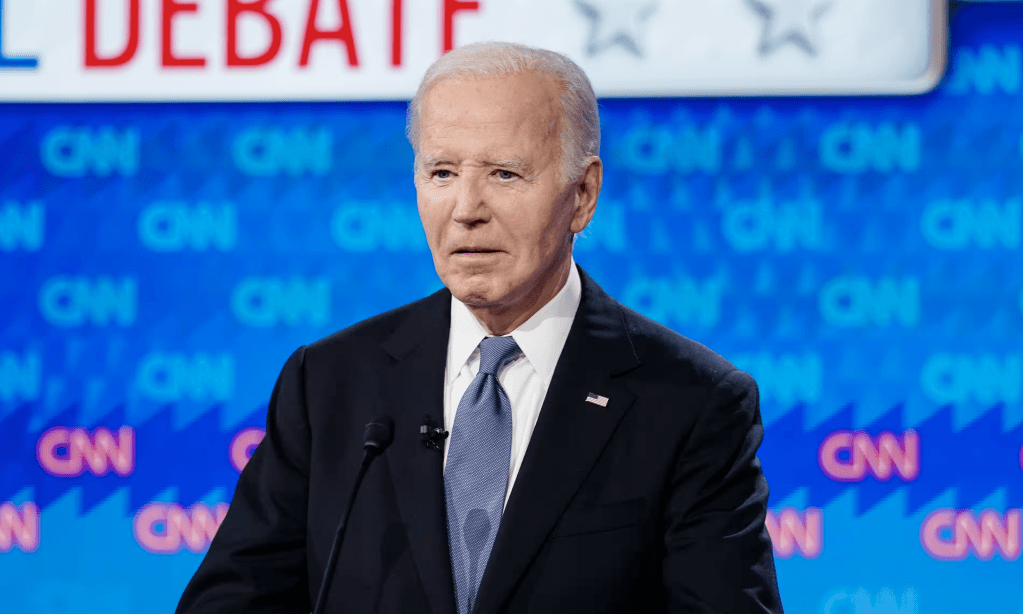
Typical Memory Care resting face. Copyright Guardian
This morning, I woke up livid. I am angry that Joe Biden has revealed himself, not as a patriot, but as the most typical, hubris infected narcissist of a politician. Last night, the mentally ill Trump rolled over and exposed his belly before Biden and his doddering, clueless opponent could not get off a single attack line. Nothing but gibberish and over-prepped 1 and 2 and 3 and 4… who the fuck cares!? I am almost inconsolably worried that in his aged incompetence Biden has now made us all vulnerable to the evil around the world. I mean, what America hater with ill-intent wouldn’t exploit this moment? As an independent voter, I depend on the two parties to bring me suitable candidates. The Democrats, faced with an existential threat to our republic, brought me that sad, barely functional mess of a man. Damn them for putting millions of us that this position.
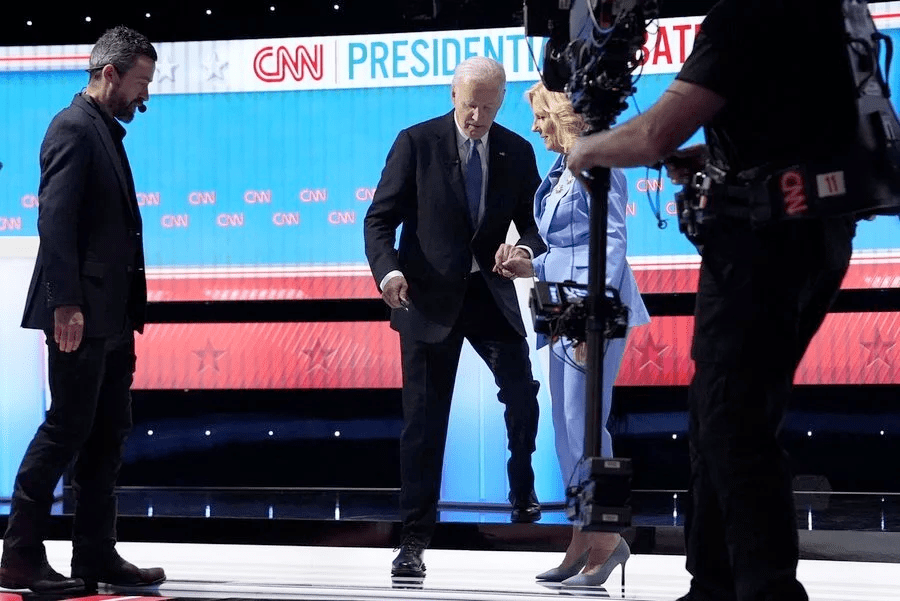
I was texting with friends last night. One by one, they said they couldn’t watch anymore. Not me. I stayed for the end and beyond. If you kept watching, here is what you saw. Typically, after a debate, the two candidates walk forward to take applause and greet well-wishers. The room was empty. For a moment, both candidates stood at their podiums, looking out at nothing. Wisely, Trump turned on his heal and left. Jill suddenly appeared at Joe’s side. Again, they stood staring at nothing. Then Joe decided to shake the hands of the CNN reporters. Jill reached and took a firm hold on Joe’s left hand. They walked forward and Joe turned sort of sideways, staring down at the first step. Jill studied the president as Joe hesitantly reached his foot out for the step. Jill guided him all the way down. Holy fuck, I thought, I have done that same thing with my 90-year-old father. Jill knows. The staff knows. Everyone around him knows. Joe can no longer function in the world without help. If he was a retired bus driver, we’d say, good for the loyal Jill. But he isn’t. His wife is the chief enabler of this charade.
The power of the presidency is a narcotic. The addiction’s most obvious symptom is a creeping narcissism. In the bubble around the White House the occupant comes to believe they are essential. Joe now believes he is the only one who can save us. He’s wrong. We would be fine without him. But the rationalization means he ignores what he knows about himself. The people around him, without considering it, become his props. They adjust presentation and schedule. They make excuses in the wake of mistakes. And, especially in this case, because he has had success and is a genuinely good guy, they don’t want to fail or abandon him. Who wants to tell grandpa it’s time to hand over the keys to the car for the safety of him and everyone else on the road?
Remember, Biden demanded t his early date to address the age questions. Sequestered away at Camp David, Biden staff saw for days what we saw last night. They knew he was finished. Do you see now why Biden has fewer open press conferences than any other president. Even Reagan, in early-stage dementia, gave more access to the media. Everyone in the White House knows. Democratic leadership knows. America suspected, but after last night we know. Joe Biden cannot serve another 4 years as President. Age comes to us all. In Joe’s case, it yelled from the screen at 45 million viewers last night.
Today, every rational analyst is calling for Biden to step down and give way to the next generation. Still, this morning he went to North Carolina and reading from a teleprompter was coherent if not feisty. Fools’ gold. His spontaneous remarks were seconds long. To counter last night’s disaster, he needs to do 4 events like that a day followed by national press conferences and one-on-one reporter interviews. He needs a hectic campaign schedule with complete openness to the public. But that will not happen because he simply can’t do it. Everyone around him knows. We now know.
The polls, which are already awful, will only get worse. I just listened to focus group analysis where potential Biden leaners all said they like him but will not support him. The only chance we have is for someone new to jump in at the convention and completely change the narrative. That’s it. Otherwise, we hand our sweet country over to Trump and the fascists. Hell, almost any other Democrat would be up 10 points today!
The two-minute ending statement at a debate is the most painfully, carefully crafted speech any candidate will ever deliver. It must be about the future. The messages are clear and repeatable. No 2 minutes ever gets more loving attention. Biden’s statement last night was utter gibberish, delivered with no clarity or passion. It was the rant of an old man too long at the bar after last call.
For me? I will not vote for Biden. Oregon is not a swing state, so my vote was always merely a signifier. Now, I will not lower my political candidate standard to support Biden. And, don’t tell me about the last 3 years. This election is about the next 4 years, even the next 100 years. If Biden stays in, well, America had a good run, didn’t it.
Generally, I try not to pay too much attention to the accidental Speaker of the House, Mike Johnson. But last night he was making the rounds of the cable news network with a simple message. (Okay, not the Biden hyped on Mountain Dew wackiness.) When asked about the Biden age issue, he had a one sentence response, “Just look at him.” Damn. The Republicans are messaging masters. Johnson didn’t have to go into specifics. Everyone knows what he meant.
lt’s amusing that the pundits are spending days blathering on about what issues will be the most important for the debate. Biden is weak on immigration and inflation. Trump is, well, Trump. His weaknesses seem to be his strength. Felon? Whatever… Misogynist… So? Fascist? Nah. Biden spends 5 days on a hilltop at Camp David preparing and Trump can’t be bothered. No, this debate is not about issues. This ain’t Lincoln v. Douglas.
Like millions of other Americans, I will spend 90 minutes trying to avoid the fetal position every time Biden speaks. Every stumble, every vacant eye stare, every mouth hanging open will be parsed endlessly and sliced into video clips to run in eternal loops on social media. Biden supporters, tell me you won’t be on the edge of your seat praying he doesn’t screw the pooch.
As for Trump, well, aren’t we also praying he shows up with his most crazy, gasping, glitching rally persona? That’s the whole ballgame. Trump must be so repugnant that Biden’s obvious flaws are okay enough. For the partisans, the election is already baked in. The entire campaign is for about 4% of the electorate in 3 states: Pennsylvania, Michigan and Wisconsin. Forget about Nevada, Georgia, Arizona and North Carolina. They are goners. 2020 putting them on the board was a Covid anomaly. And, the traditional swing states of Florida and Ohio? Ruby red now.
When, for fun, (I’m odd. I know.) I dive into social media threads about Biden’s his supporters never say he isn’t showing his age. They say, but Trump. That’s it. But Trump. I get it. I am beyond convinced, given the Heritage Foundation’s 2025 Project (If you don’t know what this is, you should.) and the fact that this time Trump will surround himself with budding fascists, if he wins, America as we have known it is done. Fini. Kaput. That is why I think that Johnson’s simple message is so devastating.
Look at him. Really watch him in public. Pull up almost any video of Biden walking out to the helicopter and tell me that stiff old man inspires confidence. We are in precarious times. Humans see age as weakness. Our culture banishes and punishes the old. “OK Boomer” For some insane reason, Democrats have given us a walking advertisement for frailty when we are craving strength and confidence.
When I geek out on surveys, the underlying numbers, the issue details, are simply bizarre. Of course, Americans are bathing in isolated Internet bubble news but areas Biden should be up are down. To paraphrase James Carville, It’s the Age Stupid. It doesn’t matter what great things Biden has done. People simply don’t think he can keep it up for 4 more years. (70% by one survey) On the most lizard brain level, that old man can’t keep us safe.
Need an example? Here’s the headline from a Washington Post survey released THIS MORNING. “Trump trusted more than Biden on democracy among key swing-state voters” I will save you pain. Don’t dig into the underlying details. It will have you reaching for the breakfast vodka.
Thursday’s debate is an eye test. If Biden passes it, we get to keep our democracy. If not, Trump is the next president. CNN put the podiums 8 feet apart. Why? Because they can get both candidates in a one shot. No jumping back and forth with camera angles. Everyone will see them almost side by side. America is comparing two old men. The winner will be the one who looks like they can handle the job for the next 4 years. Like Johnson said, “Just look at him.”
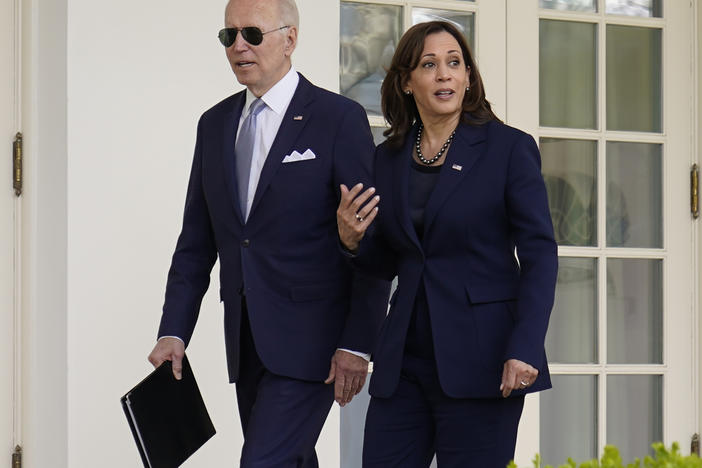
President Joe Biden and Vice President Kamala Harris walk to the Oval Office after and event in the Rose Garden of the White House in Washington, Monday, April 11, 2022. Biden announced a final version of the administration’s ghost gun rule, which comes with the White House and the Justice Department under growing pressure to crack down on gun deaths. (AP Photo/Carolyn Kaster)
I watched the Kamala Harris interview on CNN. I tried to stay hopeful. No, really, I did. That hope lasted until she fumbled the first question in a blizzard of verbal nothingness. The interviewer then tried to help her by essentially giving her the right answers, and Harris merely repeated the new question back at the questioner without raising her voice at the end of the sentence. For the next 15 minutes, the pattern continued. The interview confirmed what the political world has known all along. Kamala Harris may be the least talented politician who has ever risen so far in elected office. She talks in word salads, hold the chicken. She fills the allotted time, and you walk away starved.
We are about to get the race for president nobody wants. Trump is running and could win. His following is a cult. Rock solid. (See Tim Alberta’s amazing book.) But why is Biden running again? Some say that now he has the job he wanted so badly, he just can’t let it go. Others say he is the only one who can beat Trump. That’s what he thinks. The decision to run reeks of hubris. He told us he was transitional. He lied. But watching Harris, I think we may be missing the real reason he is running for reelection. He is a wise, old politician. He knows political talent when he sees it. When he is standing at a podium and looks back to his right at Harris, part of him thinks, “Well, I sure fucked that one up.” Biden has a Harris problem, which means we have a Harris problem too.
Think back. Why Harris? In 2020, the Biden campaign was running fumes. Harris had quickly destroyed her own presidential campaign as soon as people got a large dose of her talking. The next state in the primary was South Carolina. It was make or break. In stepped Representative Jim Clyburn. In South Carolina, especially with the enormous number of black voters, Clyburn was the kingmaker. So, Biden cut a deal with Clyburn. He promised to make a black woman his running mate. It was a good political deal. A good thing for the country. Clyburn saved Biden, and that was that.
Harris was on the short list. Biden needed a tiebreaker. I am an old dude. We can be quite sentimental. Stay on the planet long enough and the threads of your own history guide your decisions. Biden was still grieving his, heir apparent, oldest son Beau. When Beau was the attorney general of Delaware, he had worked with, and liked, the AG for California, Harris. And that was it. Biden valued the opinion of his dead son over his cold-eyed political assessment of the woman who ran her own campaign into the ground. Grief is how we got Harris.
When it was clear that Trump was running again, Biden had a fresh problem. He had a VP with lower approval polls than his abysmal ratings. He knows, we know, that Harris cannot beat Trump. Like it or not, America won’t vote for a woman for president. If he kept his word and was transitional, he was honor bound to support a Harris bid. He had to back a loser. The Democratic primary would be nasty. Biden out of the way, I can think of 5 Democratic governors with the talent and ambition to run. Every president has an enormous ego. It’s in the job description. Biden boxed himself in. His legacy couldn’t be backing a loser. He had to run. Against all sanity, an 81-year-old man with declining capabilities blocked way of talented Democrats because he had given himself no choice.
A couple of weeks ago, driving home from a movie, my wife and I had a discussion, maybe an argument. It was one of the most bizarre moments we have shared. I asked, “Would it be better for America if Biden had a stroke or fell and broke his hip tomorrow?” I advocated for a stroke because that meant Harris would be president and the party would have an immediate need to begin a primary. The hip break would leave Biden functional with the hope he could recover in time. How insane is that? Still, I wake up every day and for a few seconds before I pick up my phone, I have hope that Trump or Biden died during the night setting off a scramble to find the next generation of candidates. With either of them gone, any 60-year-old, from either party would walk away with the election.
I have never been so gloomy about America’s prospects. Trump can win this. Need a primer on what that means: The Authoritarian Playbook for 2025. Biden is fading fast. Look at his stiff-legged walk. Listen to his mumbling. Realize his staff is hiding him. He has not done a press conference since July! He can barely do one scripted event a week. We need a candidate who can do 3 a day. He simply can’t do it anymore. Of course, Trump is fading too, but like it or not, this is now a classic change election and Trump is the change. The reason that the improving economy doesn’t stick to Biden is that people are using their feelings about the economy as a proxy for ‘Biden is too damn old.’ His age overwhelms all his messages. Watch him and listen to him enough and you just say no.
Forever, I create political ads I my head for fun. Got to do them for real for a moment, too. Here is the commercial you will see. It is aimed at the swing voters in the 6 states that will decide the election. 30 seconds. The first 15 seconds are clips of Biden verbal mistakes, then of him lost on stages. There is an abundance of those available. The second half is the classic black and white video of Harris word salad. The clips where she confuses even herself are perfect. Then the screen fills with her face, still in black and white. Rising from the background is her laugh. You know the one. It is incredibly annoying. The narrator comes in to read the tag line. “WE JUST CAN’T TAKE THE CHANCE. Paid for by Trump for President.” Trump’s face in color now on the screen. And, across American, independent voters are nodding in agreement.
When I read that Portland poet Walt Curtis had died at 82, it reminded me of a different Portland. For all my precarious existence back then, I loved it. I arrived in Portland in 1982, at the worst possible time. The timber economy had just collapsed. Unemployment was about 12%. I didn’t find work for almost a year. It was me, an epileptic black lab, and a red Toyota pickup. Living in a cheap, furnished apartment in the inner southeast, every weekday, I drove to the employment office. It was a lonely time, so at night I found cheap things to get out of the apartment. One of my favorites was open mic poetry readings, a habit I picked up while briefly living in the California wine country. For a 50-cent bottle of beer, I could be around people doing something they loved. Those readings, in dives all around downtown, were how I learned my new, gritty city.
I had been writing some stories and bad poetry for years and wanted to connect with other people who had the same word problem. There was a hippy coffee house on NW 23rd that had open mics every week. For the life of me, I can’t recall the name of the joint. It might be a bookstore now. I remember that the counterculture bus service called Green Turtle used the place as its Portland depot. I may have had my first ever espresso there. 50 cents, of course, but harder to milk the time at a table over that tiny cup. I quickly saw there were stars in the local scene who showed up almost every time and who seemed to know everyone in the room. Walt Curtis looked to be at the top of that pyramid. From his work, and listening to strangers talk, I found out he was the night clerk at a truly scary little grocery store in Old Town.
Portland then was a tough place. More decaying blue collar, than an outpost on the edge of a renascence. There was no place called The Pearl, just endless warehouses that felt on their last legs. They were places where people made things and fixed things. I savored the aroma of boiling wort at the Blitz Brewery. Malt and hops molecules steamed up from a stack atop of their brewery on Burnside. And, in the first bloom of gentrification, little theater companies repurposed empty spaces and built stages for surrounded by a hodgepodge of chairs and benches. You had to have what I call “street radar” to move around Old Town and inner northwest. I learned to avoid the shadows under the Lovejoy viaduct, and which abandoned loading docks were homes for street people. With time, I began to recognize the same panhandlers, druggies and drunks nodding off against walls.
There was Elvis, a guy in a dirty tux who carried around a wood cutout of a guitar that he strummed while singing Love Me Tender. He moved in and out of the doorways of rock clubs and poetry readings. One of my favorites was an open mic regular Bad George, a drunken black Irish street poet, who some nights was too wasted to string words together. Other nights, he took requests for his amazing opus called “Bad George Needs an Apartment,” a sonnet that detailed where he did and didn’t sleep. More than once, amidst the applause he genuinely asked if anyone had a place he could sleep that night.
Many people know about the famous west coast punk rock club Satyricon. (Kurt and Cortney met there.) The venue was a dingy long hall of a bar with a stage in the back. You could smell the stale beer, cigarettes and urine up the block as you approached the doorway. What many people don’t know is that the punk scene started as an open mic poetry reading at a bar on Burnside called The Mediterranean. The Med was another narrow space of booths that wrapped around a counter just inside the front door. Almost always at that counter was George Touhouliotis the owner and impresario. Under the counter was a small refrigerator where he kept quarts of dirt cheap Bohemian beer. When street people came in the door, he would reach under the counter, put a quart in a brown paper bag for them and point at the front door. It was George who bought the Satyricon space and moved the Med poetry scene there. Punk rock came soon after. I had accidentally plugged myself into the genesis.
One night, at a reading at a slightly more upscale venue in Old Town, Walt Curtis sat next to me and struck up a conversation. I was a little excited. I chatted with this celebrity of a strange little world. He asked about where I came from and why I was there. I told him I wrote poetry but was too shy to walk up to a mic. Mostly, I was happy that someone, anyone, was willing to have a conversation with me, let alone Walt. Only later, wiser, and much deeper into the scene, did I understand that, for Walt, I was a type. Tall, slim, young, a little lost, Walt was hitting on me. When I understood the truth of that moment, I realized that the conversation had ended abruptly when he figured out I was straight. Still, the encounter meant that on other nights I too was one of his nods as he walked through rooms. That was fine by me.
A full circle, of sorts, happened a couple of decades later when I was working to get Nick Fish elected to city council. Nick had been an aide in the first campaign of Congressman Barney Frank. Barney flew cross-country to do a fundraiser in the living room of now notorious democrat powerbroker, Terry Bean. Leaning against the fireplace, flanked by two beautiful young men, was Gus Van Sant, whose first film was based on Walt Curtis’s novella Mala Noche. Bean’s beautiful home was in the West Hills. It looked out over the much-changed city. From the back of the room, I thought about the unflinching street poet still down there somewhere.
And now, one of the last breathing ventages of that special time is gone.
Tomorrow my wife will kiss me and leave for the office one last time. Of course, since I am a retired night owl, she will do that while I am blurry-eyed and still in bed. After decades of devoting her life to saving children from circumstances beyond their control, Sally is retiring as an educator at CARES NW. Not everyone gets to say that their career left the world a better place. My Sal does.
I met Sally at Standard Insurance. Napping on the couch of the breakroom, I opened my eyes to see the most remarkable pair of white, laced socks. Looking up, I saw a small woman with short curly black hair and a dead serious look. I soon discovered that behind that intensity was a woman who could be utterly goofy and willing to manifest her joy with her entire being. And the rest, as they say, is history.
From the first moments with Sally, she was on a mission. Working full time, she was also in a graduate program in counseling at Lewis and Clark. She worked around the clock to get her degree. We were together for me to see her hooding ceremony. I am not sure if I completely understood her path. Her practicum was at an inpatient facility for troubled children. She came home with stories about how she could reach little boys by embracing their love of the Power Rangers. She came up with the idea to call the boys “Healing Warriors.” There it was, Sally’s ability to use joy to connect with some of the most vulnerable little humans.
Sally is very good at smoothing over the answer to the question: what do you do for work? I, of course, enjoyed watching the questioner’s faces when I said it clearly. “My wife is a counsellor specializing in child sexual abuse and trauma.” Faces froze. Conversations stopped. When she was a clinician, I sometimes added, “Oh, she does groups with the non-offending parents. Think about that.” When they recovered, people would say something like “you are doing god’s work.” I wanted people to know that my wife had one of the toughest jobs on the planet. She faces, with compassion and determination, the things most normies don’t want to hear about. Telling the truth to others about her job was my expressing great pride. However, even now when I say that Sal is likely to give me an eye-roll.
One oddity of Sally’s work was her tools. She would gleefully come home from yard sales with children’s toys to use in her sand tray with the kids. In her off hours, she would craft signs, buttons and tags with messages to encourage clients. Intellect, compassion, and creativity: Sally used all she had to help kids recover their lives. But there was one hard and fast rule in our home. I could not listen to the details of her workday. I made the mistake of joining her for a happy hour with her peers, where they were telling war stories. Mostly women, they were all far tougher than me. I had to beg off and leave early.
My wife has always been groundbreaking in her profession. In the 90s, she devised a new way to work with teenaged girls. The punk rock world was full of ‘zines, handmade magazines using found pictures and cutout text wrapped around stories. The copier pages were then stapled together into magazines and passed around scenes across the country. She made her sample, then taught the girls how to make their own ‘zines. It was a remarkable way to have the victims regain their power and tell their story their way. I recall it was the first of several times Sally got noticed in her profession for a treatment approach.
But Sally wasn’t only saving the lives of her kids. She saved me. Some things are meant to be. I had a mental health crisis of my own around the turn of the century. One night, I fell into a state that was terrifying, what I found out is called a dissociative event. My professional wife immediately recognized what was happening and intervened with all her skill. She challenged me to think out of my narrow view of therapy and pursue a path that was eclectic then, more accepted now. They diagnosed me with PTSD from my childhood. Sally’s expertise that night, and her compassion ever since, gave me my life back. What a thing.
Eventually, even the toughest nut cracks under the weight of so many unbearable stories. Sally left frontline clinical work. But her next path, the one she is retiring from, may be the most mind-bending. She decided that the best way to help victims of trauma was to move upstream and prevent the events. And, when there are isolated, traumatized kids out there alone, train other professionals to see the signs and get the right help. Sally became a prevention educator.
But here’s the deal. While there are state and national organizations dedicated to prevention, the programs are sometimes a mess. As a former clinician, Sally had a special view of how to approach getting the right tools for the right people. She made the rounds, doing countless presentations to children in classrooms around the state. I once got to see her do her presentation. I was stunned. My mostly introvert wife is a powerhouse with a PowerPoint. She reads and owns rooms, adapting on the fly to get the messages across. Silly Sal disappears and intense, commanding Sal appears.
In the last phase of her career, Sally moved the program from teaching the kids to training the teachers and professionals. She devised a curriculum that has made her a national authority on child abuse prevention, taking her show on the road to national conferences. Sal served on the Oregon Governor’s task force on the issue and was a sought-after speaker. She has moved from saving lives one on one, and in groups, to training an army of people who can help kids. Even in retirement, they have asked her to consult statewide.
In the last weeks, as she announced her retirement, Sally has gotten the praise of her peers that she so deserves. I have had the privilege of being her support for all these years. Sometimes, my one job was to pull her into the shallow waters before she got too deep. I am busting with pride and love for Sally. And now, we get to figure out what our new life together is going to be. Damn, imagine my luck having this amazing woman as my partner to do that.
“I can’t get up in the morning without one good rationalization.” Woody Allen
When I consider the possibility that Joe Biden is going to run for reelection, I feel like I am watching the opening scenes of a dystopian movie. You know the ones. They set you up for every other disaster in the next 90 minutes. It’s as simple as this. Almost all of us have had the privilege to know an 80-year-old human and not one of us has walked away from an hour with that beloved person saying, “You know, they should really run for president.” Joe Biden, for all he has accomplished, is too damn old to keep the job. As he now rationalizes that he is the only one for the job there is a seems to be a mass psychosis where seemingly rational Americans are overlooking the obvious and joining him in his fantasy.
I get it. The guy has wanted the job for his entire professional life. He finally got his dream job, and it turns out he is pretty good at it. But he also signed up for the gig saying explicitly he was going to do two things. First, he was going to calm things down. No insane hourly Tweets. No divisive language. A return to competent governing. By my eye: mission accomplished. Thing number 2 is trickier. He said he would be a transitional president, a bridge to the next generation of leadership. I liked that. Most of us liked that. It was a recognition that there is a season for every human and this good man knew his limits. Many of us voted for him on that basis alone. But the job alters people.
As a political observer, I am among the millions who like Joe but tense up every time we see him in front a live mic. Clearly, his staff is minimizing his unscripted time. He muddles names and places and timelines. He simply wanders off into the rhetorical distance the meanders his way back to relevance. Again, this is something we expect and tolerate in our elders. We are patient and give them latitude to be their age. But it is unacceptable in the President of the United States. Worse yet, it could be fatal in a candidate for president. Joe ran the last campaign from his home basement. A real campaign is a brutal, physical challenge. We have seen younger men ground down by the process. Think of Obama, eyes blurry and voice almost gone at the end of his campaigns. It’s no game for an 80-year-old.
The power of the presidency is a narcotic. The addiction’s most obvious symptom is a creeping narcissism. In the bubble around the White House the occupant comes to believe they are essential. Joe now believes he is the only one who can save us. He’s wrong. We would be fine without him. But the rationalization means he ignores what he knows about himself. The people around him, without considering it, become his props. They adjust presentation and schedule. They make excuses in the wake of mistakes. And, especially in this case, because he has had success and is a genuinely good guy, they don’t want to fail or abandon him. Who wants to tell grandpa it’s time to hand over the keys to the car for the safety of him and everyone else on the road?
But Trump, you say. Another blathering old man, I say. Stop looking at those polls that show Biden can beat Trump. They are meaningless. Instead, look at the polls that now say a majority of Democrats don’t want Biden to run again. His base is wavering. They want him to keep his promise. Obama suppressed a new generation of leadership to make Hilary president. How did that work out? In the wings there are dynamic Democrat governors who are being suppressed by the cult of the good old guy. This is what Trump and Biden share. Rational people are afraid to say the obvious out loud. Their times have come and gone. No More Boomers in the presidency.
Then there is the Kamala problem. Her ascendancy was part of deal, the deal that got Joe off the mat in the South Carolina primary. That’s a pity because I have seen few elected officials so utterly awful at the job of politics. She is the master of the meaningless word salad, stiff in presentation and incapable of correcting any of her weaknesses. Her own presidential campaign quickly revealed all her weaknesses and she flamed out in weeks. Joe is a political pro, and he sees this. He knows she would be a disaster. He also knows that should he step aside he would be bound to support a dead bang loser and doesn’twant that to be his last act. But he must be better than that. Let Harris fall on her own, as she surely will.
If Biden was 60, I would already have a sign in my front yard. He is the only one of the last 5 presidents who knows that Putin is a killer. He has a connection, though now mostly performative, with blue collar Americans. He remains a small “l” liberal, but no longer has the energy to resist the damaging dogma of the progressive wing of the party. Joe, unlike Trump, can cut deals. Take off 20 years and I am in. But that isn’t reality. That’s the rationalization. It’s time everyone stops covering for the old guy and bring in a new generation of leadership because here’s the bottom-line, if the Republicans figure out how to dump Trump and run a vigorous younger candidate, that contrast with Biden alone will give them the White House in 2024.
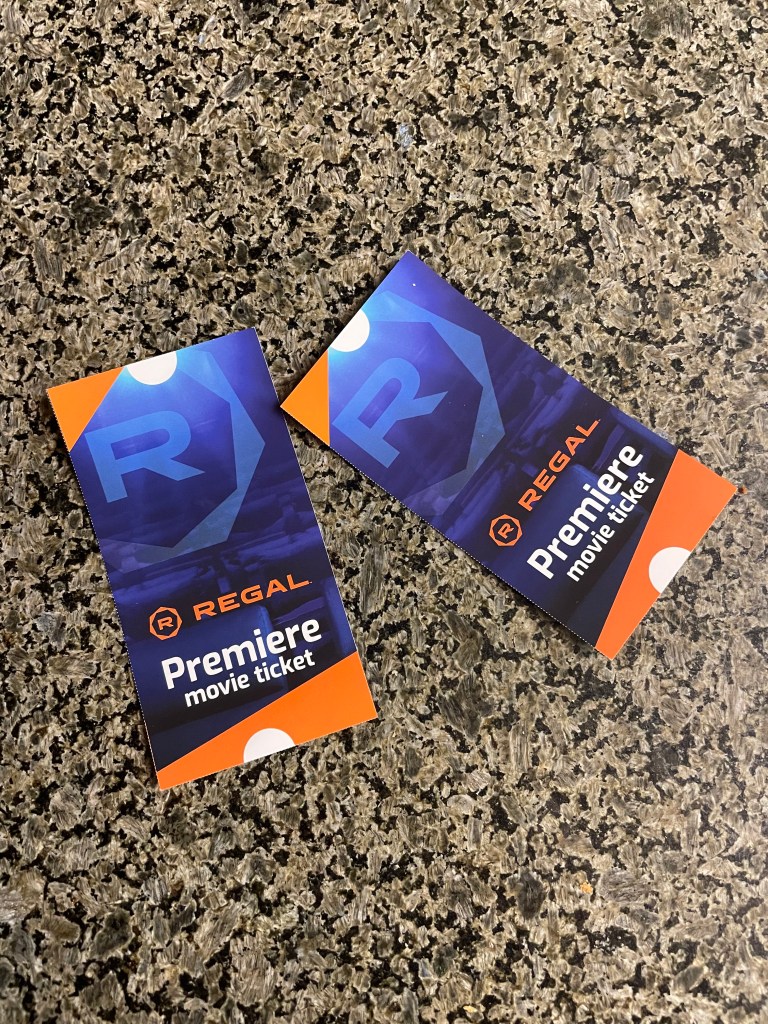
I really wanted to see a movie. Simple desire. Now that we live in the burbs, we I don’t have access to all the wonderful old theaters in the big city. I knew what I was getting into here. It’s a compromise. Sometimes, I would have to go see a movie at a Mega-Whopper-Plex. But hey, Sally’s office had “generously” given her 4 Regal passes as at thank you for a year’s hard work. An entire year. Passes in hand, we were off to Bridgeport Village Regal to see The Fabelmans.
I have never been to Bridgeport Village. That shouldn’t be a surprise to anyone who knows me. From my front porch, I can see the roof of Nordstroms at Washington Square. I haven’t been to that mall since 1985 and don’t plan on breaking that record. I was expecting a mall at Bridgeport. Nope. My first surprise was that it was some an ersatz village of places to buy and eat things. Narrow streets through retail canyons. Chain restaurants. And today, a special treat, bitter cold driving rain. Nice.
My first question for the designers. Do you hate humans? You see, the parking garage is expansive, but they strangely placed the human exits. The side of the garage facing the stores, the happy village, has no human exits or entries. Nothing. Oh, I see, it’s in a dark corner of a small surface lot on the other side of the automobile exit ramp. No useful signage, just the feeling that the designers said, “You got here genius, you figure it out.” Noted.
I was still happy to see the movie. In the Mega-Whopper-Plex world, the snacks are everything, the real profit center. But we had those passes, so we needed to talk to a human. Tucked next to the entrance doors was a lonely, confused human with a phone ear-jack standing on a sort of podium surrounded by screen kiosks.
Sally waved the passes and said, “Hello, we’d like two seats….”
Before she could finish, “The system is down.”
“What? We still want to see a movie.”
“I can’t help you.”
I looked at the surrounding screens, and they had an error message of some sort. Ear-jack was still looking around for someone, anyone, who could help him. I looked behind us at the many lines at the snack counter and realized that they had not moved since we arrived.
“Go to the refreshment counter. They can take your passes.”
I have been blown off before. This was a punt, but we obeyed the command. Sally, because it is her nature, remained hopeful. We picked a line. Behind the long counter, a row of teenagers in Regal gear were huddling with a roving boss who, by my estimate, may have been 20 years old, but he was ear-jacked which seemed to be the chevron of rank in the Regal army. Sally kept a place in line, and I wandered over to the now abandoned podium. The number of confused people in every line was growing.
To the left of the empty podium were two terminals that looked older, doing things I recognized from my IT days. Slightly staggered in their progress, on ancient green screens, they were working through what looked for all the world like a vestigial DOS PC reboot. I laughed out loud.
A woman walked up and asked, “Are they fixing it?”
“Oh yea,” I said, “by the looks of it someone has just pressed Control/ALT/Delete.” Pointing to the screen, “See, those are Windows operating system boot up messages.”
She flashed a look of recognition. Younger than me, but old enough, she knew the bitter disappointment of the Windows screen of death. She shook her head and walked away.
I went back to Sally.
“Sal, we are fucked. A crashed Windows system has killed everything in this place.”
Then behind us another ear-jack yelled, “We are now cash only!!”
I laughed again and looked down the counter. Young people who clearly had never dealt with cash without a screen in front of them to do the math were a herd of deer in the headlights. The older couple in front of us attempted to pay with a twenty. After much stumbling about, the kid handed them an uncertain amount of change and told them to just take the food. “It’s good.” The couple paused, looked around like thieves, and made their escape.
Counter Ear-jack had gone down the line handing out pens, pencils and little pieces of paper. A lad to my left stood looking at the pen in his hand as if an alien had just handed him a rectangular egg. The surface tension of basic technology, upon which he relied, had broken, and he was sliding into waves of chaos.
To her credit, Sally went into problem-solving mode.
“We have these passes. Can you just take them and write a note that we have paid then we can still go to the movie?”
The Regal soul presented a look like he had just time-shifted into a Fellini movie and Sal was speaking Italian.
“This will not work,” I whispered to my wife.
“The can figure out how to adapt to this,” she insisted.
“No, honey they can’t. Look around, no one prepared for this. There is no plan. They assume the tech will always work.”
She persisted, trying to help the dazed kid. Finally, he handed the passes back and said, “I can’t do it.”
At last, some truth.
I nudged Sally to leave. The crowd of the confused was growing with more victims still coming in the doors, blissfully unaware that, in this place, at this moment, their world had ended. Self preservation alarms went off. This could get ugly. I mean, they were there to watch more violent Marvel movies. Too many aspiring superheroes for the room to stabilize.
“But they aren’t problem solving,” said Sally.
“I know. We are old. We know how to do that, but they don’t know how. Honestly, look around. Look at their faces.”
Still, my wife wasn’t done. A female ear-jack, a tribal elder in her early 20s, had assumed the power position at the podium. Sally walked up to talk to her. I went back to the two screens. Now they were flashing messages that said they couldn’t find their DHCP server. I laughed harder than before. Basically, ET was trying to phone home, and the Internet had abandoned him. I walked back to my persistent wife.
“…but the system is still down. We can’t take those passes,” said elder female ear-jack.
I touched my wife’s shoulder. “Sal, it’s over here. This will not get better.” Female ear-jack looked down and offered what she could, the generic customer service smile. We walked away.
Back in the cold, apocalypse Sally told me what she says all the time.
“I have no expectation that we will always have power 24-hours a day.”
“I know. I know. Those kids in there are the resilient Zs we hear so much about. We just got a small taste. By the way honey, I am pretty sure that this theater gets its movies across the net. They digitally stream like everyone else, just with insanely expensive popcorn and vats of pop. So, my guess is that if there are people who made it into the theaters, they are sitting in the almost dark waiting for the Windows reboot too.”
We did not waste the afternoon. No, we got a benign preview of the collapse of civilization. But I still want to see that Spielberg movie.
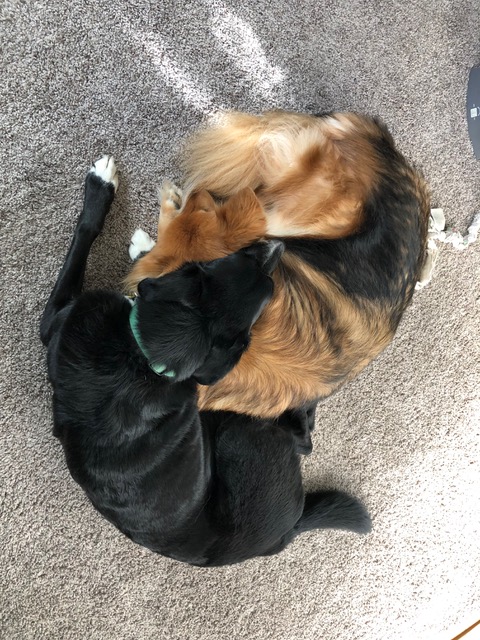
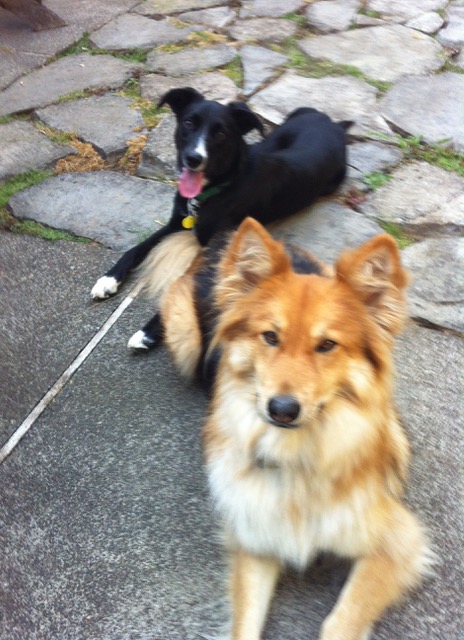
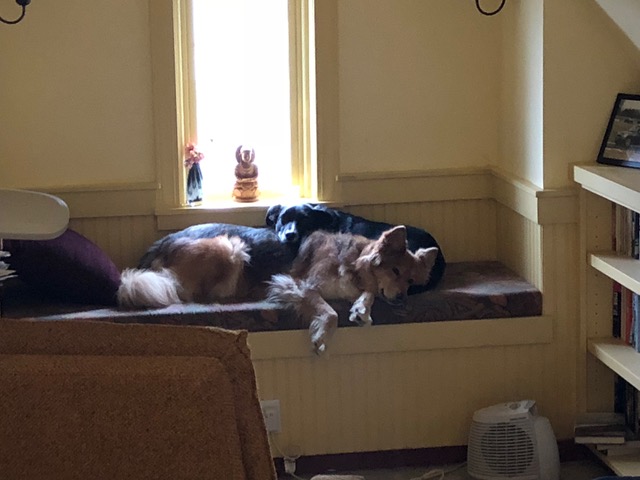
Mozy had been with us for over a year when Zoom arrived. We were cautious about how they met, backyard first so neither of them felt hemmed in. After a few sniffs, and the new boy demanding some play, they were bonded. I found pictures of Zoom that day, malnourished and jet black except for his white fur edges. I had forgotten how quickly Zoom was a shadow to his new big sister. Theirs’ was a tactile relationship. A paw, a head, a back, a neck, always in contact. And, if there was a squirrel to chase, they streaked off as a team. They would run side by side up to the little window above our library seat to monitor Sally and I coming and going. We learned to look up to see two dog faces smooshed together behind the narrow leaded glass. And sometimes, on a signal we humans could not discern, they jumped up from a sound sleep, ran up the stairs to the little window and assumed their post as second floor sentinels over the neighborhood.
The Day They Met
As age and disease crept up on Mozy, we both worried about Zoom. Mozy was Sally’s dog. Zoom is my little boy. If there are two dogs and two people, the dogs pick. That’s just the way it is. I had seen the breakup of our first pair where the survivor went into a deep funk and essentially gave up living without her companion. With every step to the end of Mozy’s life, my worry about Zoom increased. I read the stories about dog depression and how to help a dog who lost their partner.
After a normal, if not lively, evening, around midnight, Mozy fell into a health crisis. She made a rapidly approaching decision for us. I could get a vet here at 3 AM. I warned the vet that Zoom would bark and challenge her, as he did everyone (his Border Collie half protecting the herd) but that he wasn’t dangerous and would quickly calm down. Some say it is easier on the surviving dog if they are there at the end with their partner. I wasn’t sure. Quickly, there were three humans and 2 dogs on the floor of our bedroom. Sally was whispering into Mozy’s ear. I had Zoom in hand. At first, he was shaking but settled facing Mozy. He gently sniffed her nose to nose. I wondered if he knew what was coming. Maybe so. At various moments, he checked Mozy, my hand on his collar. When Mozy died, I let him go. He sniffer her up and down, even followed her out to the vet’s waiting car, stopping one more time to look at her face to face.
She Charmed Carrie and Fred.
We vowed not to leave the little guy alone for a few days. More than usual, he marked my every move. There is this thing that happens to me when a dog is gone. I have a strong sense of unoccupied space at the bottom of my vision. Mozy’s loss magnifies this feeling as she had depended on us for basic things for a long time. We helped her to her water and food dishes. Kept a schedule to relieve herself. We often walked out into the backyard, in all weather, to rescue her from her endless clockwise circling as she hunted for the door back to the house. Thinking about it now, it is remarkable how we came to accept her challenges as normal. I know from experience that, as surely as water levels when swimmers leave the pool, the emptiness finds a new equilibrium. Still, I catch myself automatically stepping around where Mozy used to lay.
Two days after Mozy died, I picked up Zoom’s food dish for dinner. There was something wrong. The stainless-steel bowl was a little dirty, some kibble crumbs and a hint of water. The sight caught me up short. I didn’t figure out what was wrong until I stood, filling his bowl with food. In all the time we had Mozy, I had never seen a dirty dog dish. The Collie-mix loved her food and lick-shined both dishes seeking the last molecule of goodness. Mozy woofed down her meals. Zoom is a slow, picky eater. Always done first, Mozy to stood patiently behind the little boy until he finished to lick his dish until we told her she was done. Late that night, I watched Zoom sleep and wondered if Zoom missed the ritual licking of his bowl.
The last couple of months, Zoom had been more and more watchful of Mozy. I believe, with their keen sense of smell, dogs know about disease in ways we can’t understand. When she became blind, he was sweetly tolerant of Mozy stepping on him while he was sleeping. He moved to accommodate her. Lately, when it was time to go outside, he didn’t run off; he stood near the door and waited for slow Mozy to come out with him. When the blind girl got stuck in the bathroom behind the door, he came to get us to free her. And, when she had an accident somewhere in the house, Zoom changed his aspect with us to tell us to fix it. Maybe I was just more aware, but it sure seemed like he was staying closer to Mozy.
It has been a week since Mozy left us. It will take more time for the clouds to lift. We try to fill Zoom’s life with his favorite things. He is getting longer walks and more frisbee. He is still sticking close. While I will never know, it sure seems like Zoom knows that Mozy is gone and never coming back. But like us, I am also convinced that he too sees a ghost dog in his world.
You never forget. Just like riding a bike. Something I reminded myself as I extracted myself from an Alder tree.
In the memory fog, most of us have a rite of passage story about our first bike ride. It’s the moment we discover the alchemy of balance and forward motion. Finally, our little legs can escape our parents or siblings. The first unassisted bide ride is a parent letting go, maybe for the first time. The breeze in your face is a sign you are moving both further into and away from childhood.
As a new college student, I assumed I needed a bike. Coming from a family that fetishized automobiles, I don’t have a clue why. Perhaps it was the television shows and movies where every campus background had 10-speed bikes buzzing back and forth. I imagined I would ride my bike to class and to, well; no idea where. I bought a 10-speed. At school, I locked the pristine white bike into the rack on my dorm patio and never rode it. Not once. In fact, I didn’t know someone had stolen it until the police contacted me. Worse for wear, I locked the bike back on the dorm patio. No idea what happened to it. Maybe it was stolen again because it never made it back home.
The longer I was in Portland, the greater my ambivalence, if not hostility, to the entire concept of bikes. Well, not exactly the mechanical conveyance itself, but Portland bike riders. I get bikes are an elegant way to amplify human muscles. Unfortunately, there is a notion that owning Spandex and a bike helmet are an anointing. And with God’s anointment comes the belief that almost anything done on a bicycle is God’s work. And, given God’s grace, there was no reason to follow the traffic laws that bound the rest of us planet haters. I lost track of the number of times my quick reflexes at the wheel saved the life of a bike rider. The most common thank you was a middle finger. God’s work.
Middle-aged idiocy put me on a bike once more. At about 50, I decided that I finally needed to be a jogger. I got the right shoes, read the right books, bought the right clothes, then out into the night I went to aimlessly circle a Mt Tabor reservoir. As the gasping and wheezing settled, I enjoyed the solitude and the biting cold. Then my feet failed… badly. Seems that St John’s Bridge level high foot arches with a few decades of wear are not made for jogging. I damn near crippled myself. Ordered by a doctor to not do that again, he suggested that biking was a safer workout. Safer being relative.
So, there I was in a neighborhood without a single level street with my first bike since college. My first impression was that since I last rode a bike, they had gotten taller. I looked down at the passing asphalt and got a chill that never happened when I took my Mini Cooper out on high-speed racetrack days. But I stuck to it, making my way further and further up the park’s cinder cone and back. But that was it. I had no desire to go anywhere else. My new bike was medicinal. I got some fresh air and a little workout. After a few months, my feet healed. My bike sat in a rack at the back of our garage. One day, after a quick trip to the store, I pulled into the driveway to see it was gone. Two thoughts: Some asshole came up our driveway with Sal home and took my bike. Damn it. And… good riddance. I hope they get some use out of it.
Flip forward to a Social Security card and our move to Tigard. During the house search, I nurtured a new fantasy. I said to anyone who would listen, there’s an isolated bike trail along Fanno Creek, “I am thinking about a bike.” Laughing ensued. In my newly addled mind, I was highly motivated because just over a mile down that isolated, mostly flat trail, there were 3 taverns. Cold beer. A noble pursuit. Sal, who once commuted by bike, was thrilled. “We can ride together,” she gushed. Happy wife….
Armed with Google and YouTube, I dove deep to find the perfect old dude bike. As a modern hunter/gatherer, I was now an expert. After mowing the yard at our now old place one last time and heading to the new home in Tigard, I stopped at a bike shop, walked in, saw the bike I wanted, and pointed at it. “I’ll take that one.”
The young woman greeted me, looked confused. “You don’t want to look around? Can I ask you some questions? Let me help you.”
“Nope, I’m good,” I said with unearned confidence. “I now live next to Fanno Creek Trail and this is what I need.”
“You want to ride it on our indoor track?”
“Nope,” I said, horrified that someone would watch this old man get on a bike for the first time in over a decade.
“Well, let’s at least size it for you.”
“And a helmet. And one of those water bottle things. A bell. I need one of those bell things. How many bell options? Good lord. No, let’s keep it simple. Can I take it all now?”
“Of course.”
“Easiest sale you have ever made I bet.”
“Different,” she responded.
I’m bizarrely stubborn, a trait for good or not. It’s important to know that as you read this next part. In the last few years, I have gained a couple of vestibular syndromes. Vertigo. Seems one inner ear doesn’t always sync with the other one. That means my world can get a little off. Turn my head quickly and it’s like my eyes are trying to catch up with what they are seeing. At its worst, I can’t drive. Doing hours and hours of PT and regular home exercises has taught my brain to mostly ignore the unsteady world when this new unbalanced feature kicks in. A rational soul might say I wasn’t the perfect candidate to take up bike riding. But a trail. But taverns. But new toys!!!
Our house has a steep driveway, so I pushed my new bike out to the sidewalk. I told (warned?) Sally that I was going for my first bike ride. She was almost gleeful. Was that the same reaction my folks had the first time I stayed up on a two-wheeler? Phone in my pocket, just in case. Helmet uncomfortably pulled down tight. I straddled my bike and pushed off. OH SHIT! While you don’t forget how to ride a bike, that doesn’t mean you are immediately good at it. Turns out, our street cascades down to the creek. Okay, not cascade so much as it leans. I gained speed too fast for my muddled reaction times. Hell, I didn’t know which brake worked the front or back. I kept looking down to figure it out. And the height. Good god, I am up in the air. Which gear? How many of those do I have anyhow? Where are those brakes? Damn it! Slow down! Cars? Are there cars at the intersection? I don’t think I can turn around and look back without crashing! Panicked, I pulled to the curb and stopped. Well, kind of stopped. Maybe bounced off the curb and dragged my feet. But I didn’t fall over, which I counted as an achievement. Assuming a nonchalant pose I had seen a thousand times, I reached down and pulled out my water bottle, took a swig, and looked around disinterestedly. I had ridden one block.
Braking constantly, I eased myself down to the trail. Ducks. I see ducks. Don’t look at the damn ducks!! I hadn’t counted on the fact that the paved trail would be so narrow. Okay, it isn’t narrow, but now I was horrified that some other biker would come at me from the opposite direction. The first time it happened, I almost rode off the trail as my arms locked like rusty steel pistons. I rode to the first trail exit and exhaled in relief; fiddling with the mystifying gears as I made it up the precipitous rise to my house. Right, maybe a gentle rise. Huffing and flush with victory, I walked into the house and loudly announced I was back. “Okay honey,” was all that Sally said, clearly not appreciating the magnitude of my victory over time and balance.
By my third ride, I had expanded my orbit. But nothing felt natural about riding the bike. I still glanced down at the brakes as I applied them and tried little memory tools to remind me how and when to shift up or down. For reasons that escape me, instead of looking around, I watched my front wheel. It was as if I was an enormous antibody attempting to isolate and kill the toxic invader between my legs. I came to a blind corner and thought about ringing my bell. I mean, I had a yet unloved bell. I looked down at the bell, then back up. At the apex of the corner, in the middle of the trail, was a small Latino man, his bike and bundles. He was tinkering with something. Have you ever watched your brain work? My noggin was saying: Brake? Front or back. Both? Go right and try to sneak by him? Bell? What? Hit him? Left. Go left and you will be fine. I did none of those things. Braking far too late, I went straight across the trail toward Fanno Creek plunged into an Alder tree. Face first.
Suddenly, there was no motion, just confusion and some pain. I looked down to see my front tire hit the trunk dead on. Well, at least I didn’t ride into the creek. My helmet was askew, glasses hanging from one ear. My body seemed fine, well, except for one knee caught in the briar. My face hurt as I scratched it in several directions. I yanked the bike back onto the trail. The small man, eyes red with some sort of substance abuse, stood next to me, almost face to face. In any other circumstance too close, but now vaguely comforting. He said nothing as he pulled bits of twigs and leaves off my face, brushing them away with the side of his hand. I recall he did so in the most delicate way. He stepped back, and I put the bike on its stand on the other side of the trail. It looked to be all in one piece. I thought to summon the little Spanish I know, but no phrase I knew would have been meaningful. I think we simple exchanged “Okay” back and forth a few times. Then he was on his way.
Still shaking, I rode home. In the bathroom mirror, I saw I had some scratches deep into my beard and a bump on my face next to my left ear. I said out loud, “Are you fucking kidding me? The third time. Are you fucking kidding me?” Uncapping the hydrogen peroxide, I asked myself if I really needed to be a bike guy. What in the world was I thinking? But here’s where being stubborn is a good thing. I know all about trauma. On the ride home, I felt familiar sensations erupting in my body. Icky levels of adrenaline. A certain recoiling away from harm. I had trouble sleeping as I replayed the feeling of helplessness as I lost control of the bike over and over. Slow motion self-torture. But the next day, with Sally at work, I said to myself, “No goddamnit. Not this time.”
I was determined to do the same ride. Back to the scene of my crash, before the blind corner, I stopped, parked the bike, and walked the trail. I ducked as a branch was hanging out over the trail at the bend. What? On my bike, that branch would have hit me in the face. Somehow, I had edited that detail out of my replays. I had to be ducking that branch as I rounded the corner. No wonder I had so little time to react. I walked to the place where the little man had parked and looked back. My god, even as slow as I ride, there was no way I could have avoided what happened. I shook a little, fighting back tears, took a few deep breaths and got back on my bike to finish the ride that had ended so abruptly the day before. Not this time trauma, not this time.
A week after the crash, my face had almost healed, except for that bump near my ear. One evening, I scratched the itchy bump and felt something hard. I looked at my finger there was a part of an Alder twig that had worked its way out my head. Bike rider and part tree. Perfect. I took rides the rest of the summer. On vacant streets, I practiced swerved around leaves on the ground reminding myself what the little boy me did naturally. The brakes and gears came more naturally. Still wary, I took the trails slowly. No need for this old dude to be in a hurry. But here’s the funny part. From August on, Fanno Creek Trail was closed north and south of our home by park and trail construction. I never made it to that tavern. Instead, I stopped to look for a Blue Heron who I saw now and again. I still clench a little when a bike or a walker comes toward me and let out a relief breath when I am by them. But I also share nods with the approaching strangers because that seems to be what bike riders do. My bike is tucked away for winter now. Come the spring, those taverns will still be there.





 NO CLOCK